
Optical cameras only work on clear nights. Radar works all the time: it scatters radio waves off the ionized trail a meteor leaves behind. The Canadian Meteor Orbit Radar (CMOR) has been doing this since 1999 and has logged more than 20 million meteoroid orbits — the largest such dataset in the world.
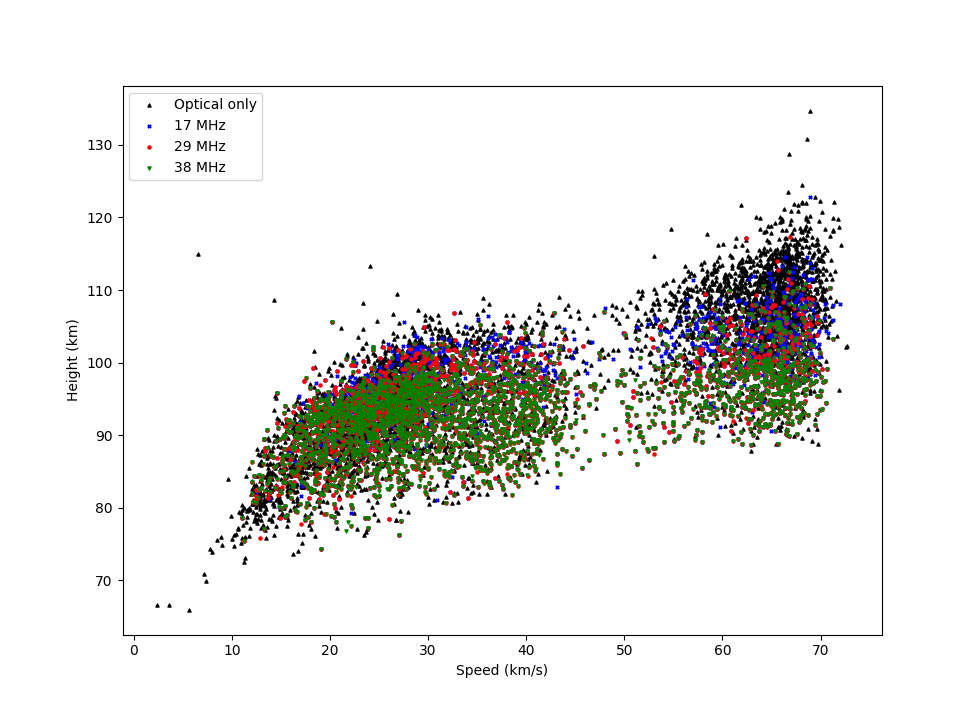
CMOR transmits at three frequencies (17.45, 29.85 and 38.15 MHz) into all-sky beams, with remote receiver sites that triangulate each echo to recover a full orbit. The multi-frequency design lets us disentangle observing biases such as the initial-radius or height-ceiling effect.
What the radar tells us
- A continuous, near-complete census of the sporadic meteoroid complex and the radar meteor showers feeding dust to the Earth.
- New techniques — including the Fresnel transform and forward-scatter methods — that measure individual meteoroid speeds and decelerations to high precision.
- Mass indices and fluxes for meteor showers, which helps quantify the impact risk to spacecraft.
- Meteor radars also probe the upper atmosphere: CMOR winds are compared with satellite (TIMED) and global circulation models.
Work on this as a student
Measure meteoroid speeds with the Fresnel transform, or use multi-station radar decelerations to weigh individual meteoroids.
Key publications
- Webster, A.R., Brown, P.G., Jones, J., Ellis, K.J., Campbell-Brown, M. 2004. The Canadian Meteor Orbit Radar (CMOR).
- Kipreos, Y., Moorhead, A., Brown, P.G., Campbell-Brown, M., Cooke, W. 2025. Improved measurement of radar meteor shower mass indices. Icarus.