
The faintest meteors are by far the most numerous, and each one is a natural experiment in how a millimetre-sized grain from a comet or asteroid falls apart. Using advanced models of meteoroid ablation we can invert meteor measurements to estimate meteoroid physical properties. To unravel the structure and material properties of a meteoroid you need to capture the meteor burning up with high temporal and spatial resolution.
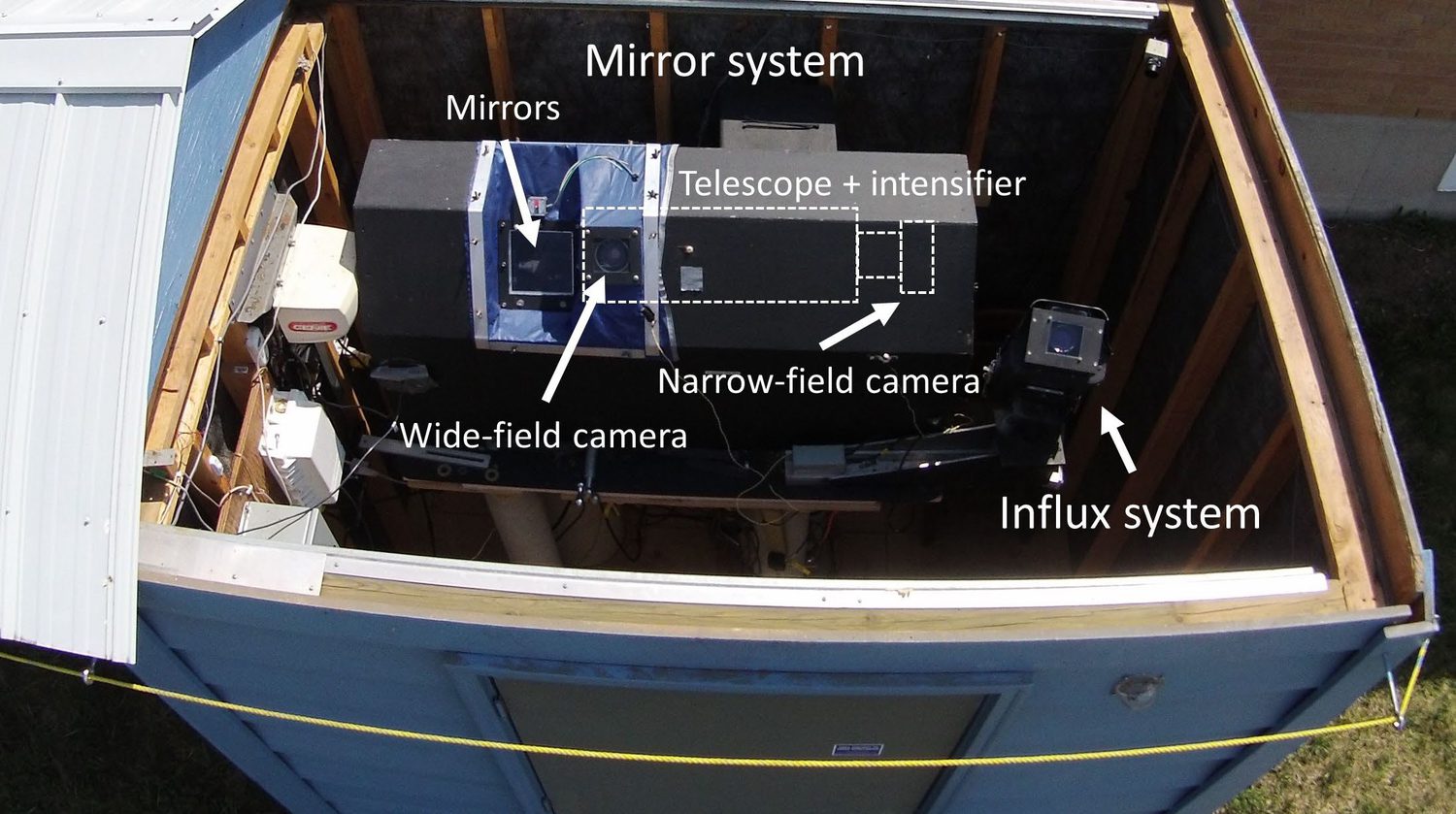
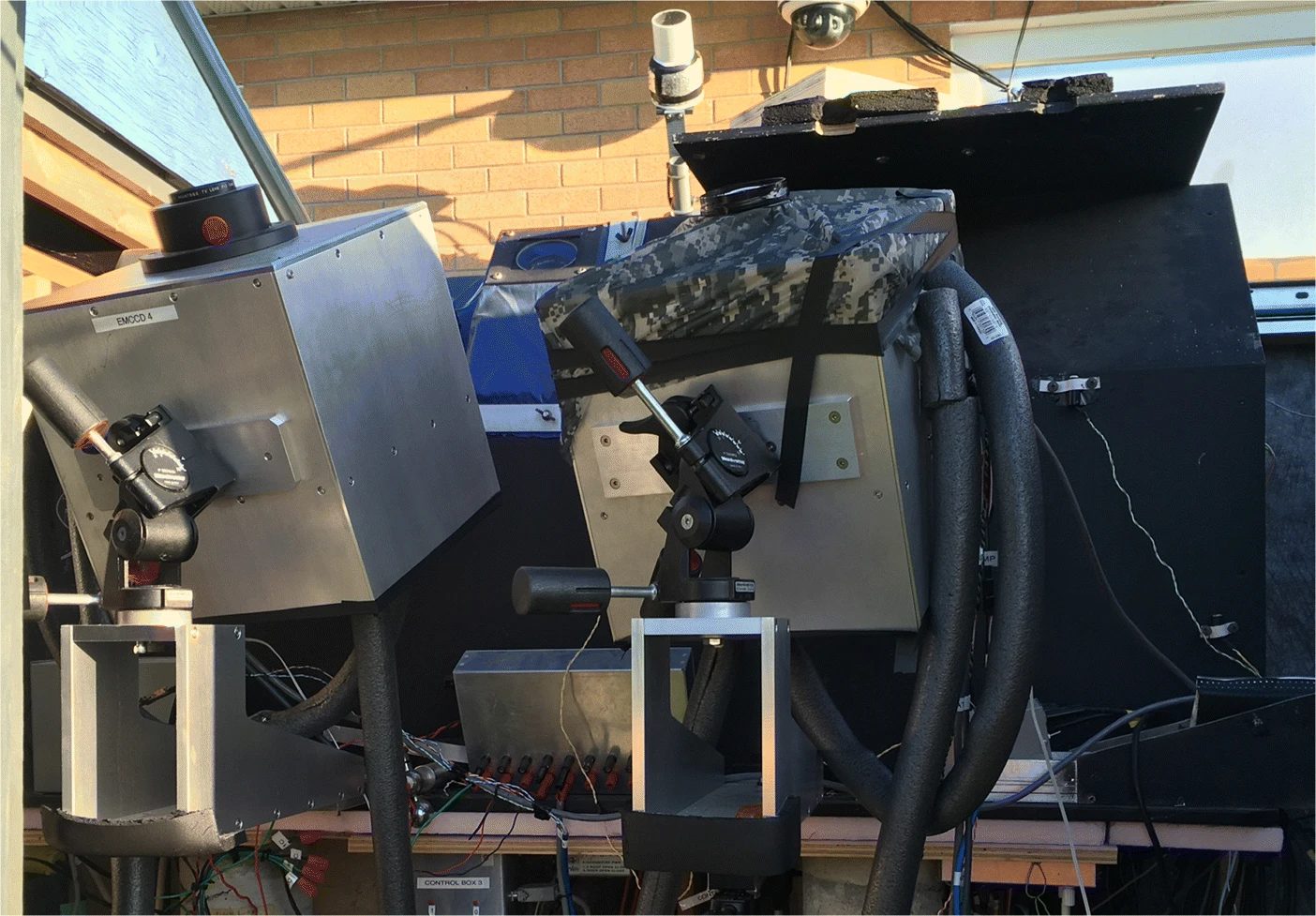
The Canadian Automated Meteor Observatory (CAMO) does exactly that: a guided mirror tracks a meteor and feeds a narrow-field telescope, resolving the glowing trail with a resolution of about 4 metres at 100 km altitude. A complimentary network of electron-multiplying CCD (EMCCD) cameras records the orbits and light of from thousands of faint meteors.
What we have found
- CAMO’s metre-scale imaging shows that essentially all faint meteoroids fragment as they ablate — the “dustball” picture, seen directly.
- An EMCCD survey of more than 100,000 faint-meteor orbits revealed a surprisingly large population of slow iron meteoroids — perhaps 20% at millimetre sizes — in tension with models.
- Simultaneous radar + optical observations let us measure luminous efficiency and pin down meteoroid mass, density and strength.
The cameras are sensitive enough to detect meteors much fainter than can be seen with the naked-eye, opening up a meteoroid size range close to where most of the mass entering the atmosphere actually lives.
Work on this as a student
Correlate the physical behaviour of the faintest meteors ever recorded with their orbits, or model meteoroid ablation from joint radar–optical data.
Key publications
- Vida, D., Brown, P.G., Campbell-Brown, M. 2018. High-precision measurements of meteoroid compressive strengths from direct observations of fragmentation.
- Subasinghe, D., Campbell-Brown, M., Stokan, E. 2016. Physical characteristics of faint meteors and the implications for parent bodies. MNRAS.