
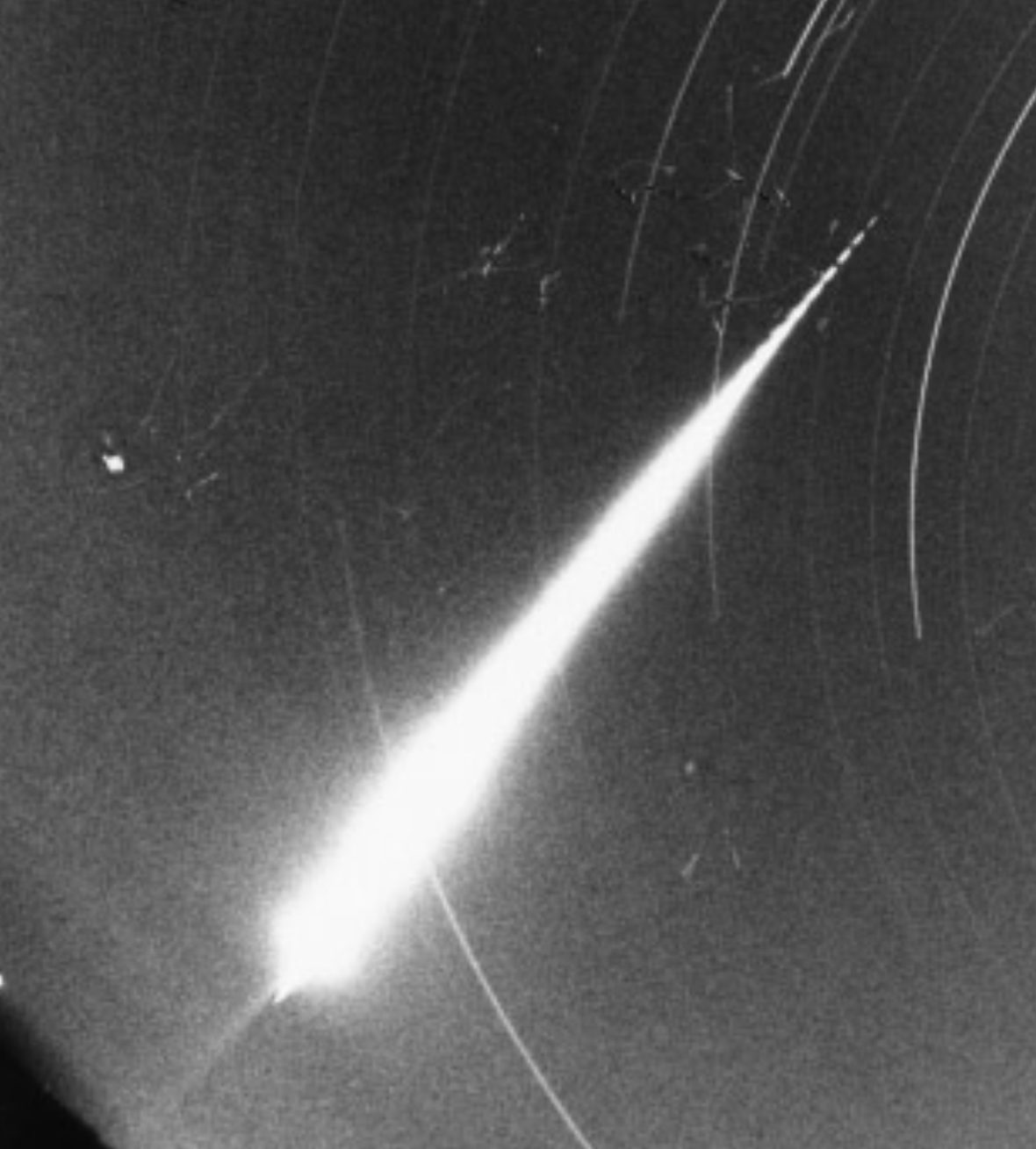
A rock the size of a car hits the Earth’s atmosphere roughly once a year; one the size of a house, every few decades. Knowing how often — and how much damage an airburst can do at the ground — is the science behind planetary defence.
We measure the flux of metre- to decametre-sized impactors using sensors that watch the whole Earth: US Government satellite sensors (catalogued by NASA’s CNEOS fireball database), the GOES Geostationary Lightning Mapper, and ground-based infrasound. We then model what happens as these bodies ablate, fragment and explode.
What we have found
- Our satellite-derived collision rate (Brown et al. 2002, Nature) and the Chelyabinsk analysis (Brown et al. 2013, Nature) are now the standard reference flux of metre-sized impactors, used in NASA and US National Research Council studies.
- The 500-kiloton Chelyabinsk airburst showed window-breaking damage of that kind should occur somewhere on Earth roughly once every 600 years — more often than previously assumed.
- Most metre-sized impactors come from the inner main asteroid belt; about 10% are on comet-like orbits but are structurally indistinguishable from asteroidal bodies.
- Ground damage from airbursts is best explained by a cylindrical shock geometry, not the spherical (nuclear-weapon) geometry used previously — now folded into NASA’s operational impact-risk models.
- The Taurid swarm may carry a coherent population of larger objects, with implications for close approaches in 2032 and 2036 (Boslough, Brown et al. 2025).
This work feeds directly into the tools NASA’s Planetary Defense Coordination Office would use if a short-warning impactor were discovered, and even helped recalibrate the seismic detection of impacts on Mars by the InSight lander.
Work on this as a student
Mine the CNEOS and GOES-GLM databases for metre-sized impactors and shower fireballs, or model the airburst of a real event.
Key publications
- Brown, P. et al. 2002. The flux of small near-Earth objects colliding with the Earth. Nature 420, 294–296.
- Brown, P.G. et al. 2013. A 500-kiloton airburst over Chelyabinsk and an enhanced hazard from small impactors. Nature 503, 238–241.
- Chow, I. & Brown, P.G. 2025. Decameter-sized Earth impactors – I: Orbital properties. Icarus 429, 116444.
- Boslough, M., Brown, P.G. et al. 2025. 2032 and 2036 risk enhancement from NEOs in the Taurid stream. Acta Astronautica.
See also: fireball videos and satellite-detected bolide data.