
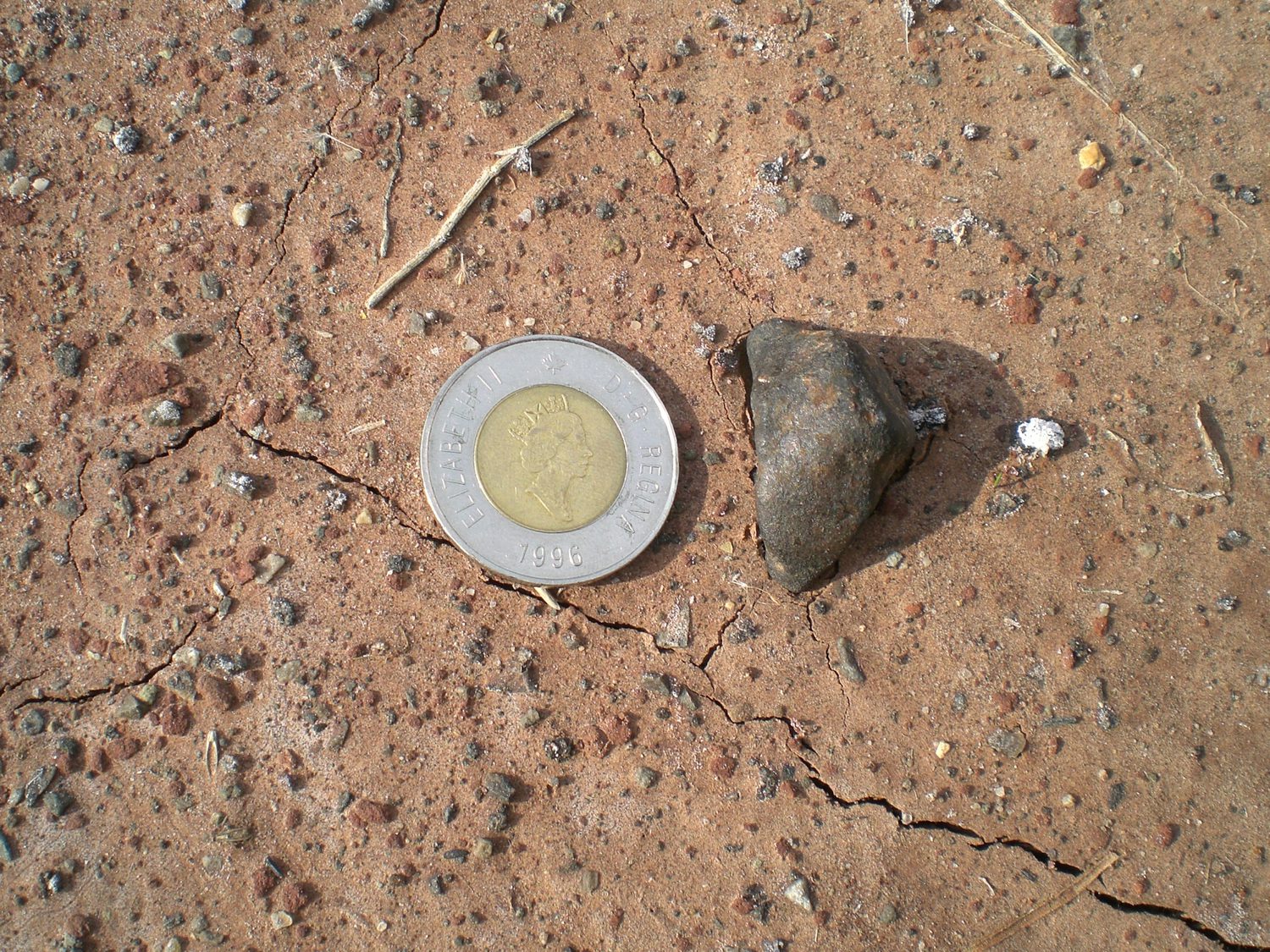
Most meteorites are rocks without a return address. But if you record the fireball which produces the meteorite, you can reconstruct its orbit — and link the rock in your hand to a specific region, or even a specific family, of asteroids.
I have led or been part of teams that analysed or recovered roughly one third of all meteorites with instrumentally measured orbits. Each one is a calibration point tying a meteorite type to a birthplace in the asteroid belt.
Some of the falls we have studied
- Tagish Lake (2000) — a pristine carbonaceous chondrite, now the most-studied Canadian meteorite and a ground-truth sample for the Hayabusa2 and OSIRIS-REx asteroid missions. Likely formed in the outer solar system near Saturn. Full story ›
- Hamburg (H4) most likely escaped the main asteroid belt through the 3:1 resonance with Jupiter, reinforcing an inner-belt origin for H chondrites.
- Golden (L/LL5) fell on a high-inclination orbit that is hard to reconcile with the presumed inner-belt Flora-family source for LL chondrites.
- Almahata Sitta / asteroid 2008 TC3 — the first asteroid detected before it hit, which turned out to be a rare Urelite meteorite but also a rubble-pile mix of other meteorite types.
- 2023 CX1 — one of only a handful of asteroids predicted to impact and then recovered; we showed its catastrophic disruption in the atmosphere happened deeper than normal hinting at an as-yet uncharacterized but more dangerous NEA population (Egal, Brown et al. 2025, Nature Astronomy).
How precisely you need to measure a fireball to make these links is itself a research question — our orbit-uncertainty analyses are used by camera networks worldwide as they set their design requirements.
Work on this as a student
Use the JPL/CNEOS fireball catalogue to work out the orbits and physical properties of metre-sized Earth impactors.
Key publications
- Brown, P. et al. 2000. The fall, recovery, orbit and composition of the Tagish Lake meteorite. Science 290, 320–325.
- Borovička, J., Spurný, P., Brown, P.G. 2015. Small near-Earth asteroids as a source of meteorites. In Asteroids IV, 257–280.
- Egal, A., Brown, P.G. et al. 2025. Catastrophic disruption of asteroid 2023 CX1 and implications for planetary defence. Nature Astronomy.