Radar Meteor Observations
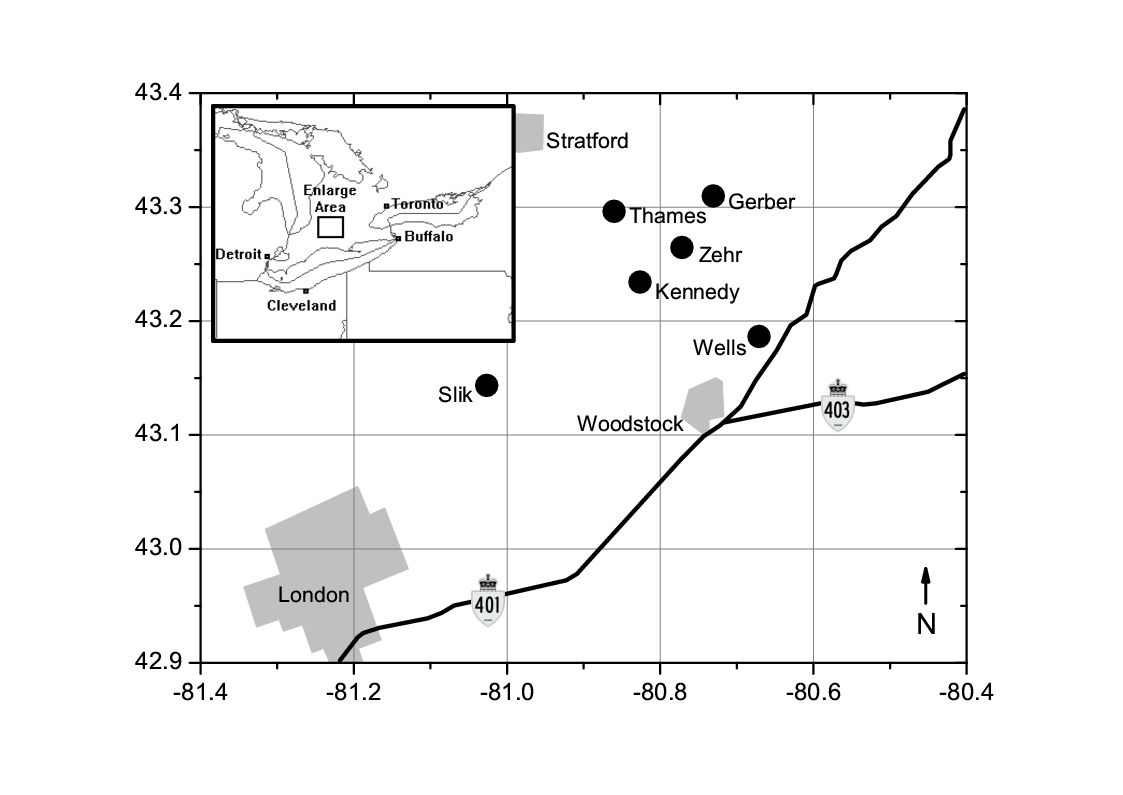
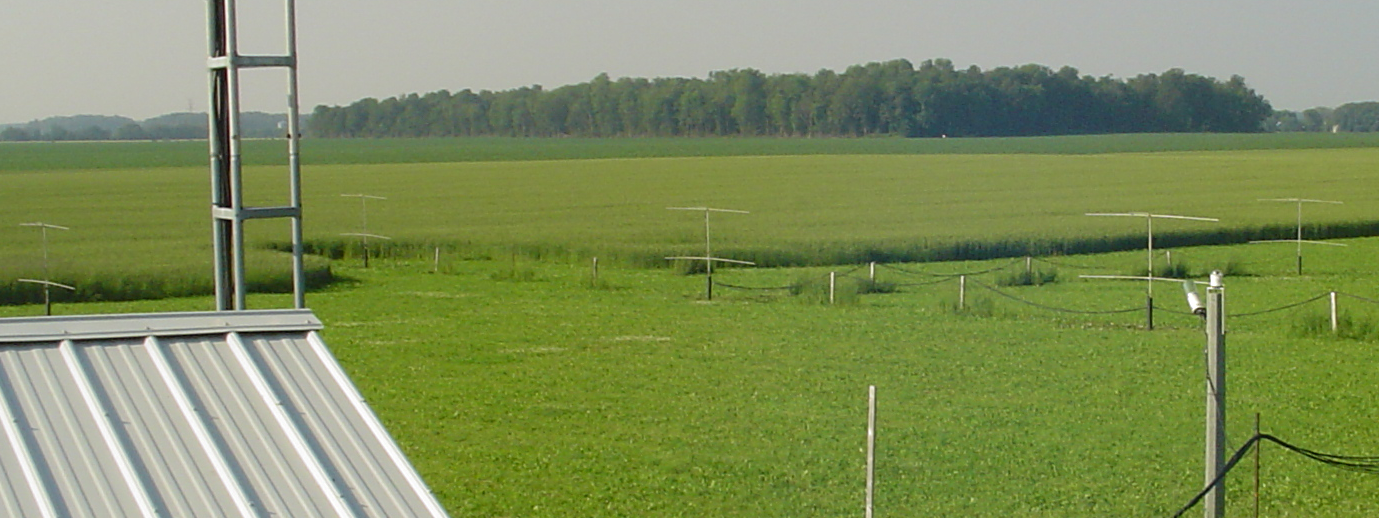
The Canadian Meteor Orbit Radar (CMOR) is the primary instrument for large-scale meteor survey work in our group. Operating simultaneously at three radio frequencies (17.45, 29.85, and 38.15 MHz) from its central site near Tavistock, Ontario, CMOR detects meteors via specular backscatter from the ionization trail left as a meteoroid ablates in the mesosphere and lower thermosphere (roughly 70–120 km altitude).
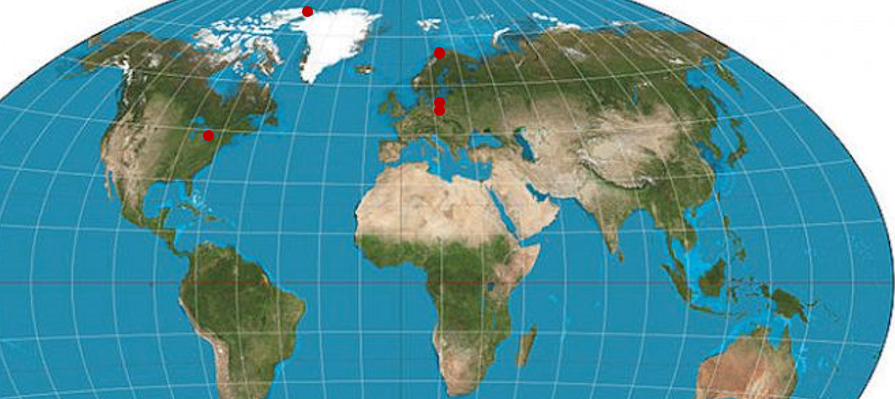
Each detected meteor echo yields a geocentric radiant, speed, and heliocentric orbit through interferometry across five receiving antennas and three outlying forward-scatter stations. Since 2002, CMOR has accumulated more than 25 million meteor orbits, the largest single-facility dataset of its kind. An additional 150+ million single-station echoes provide high-cadence activity monitoring without orbital solutions.
The multi-frequency design enables direct cross-calibration and measurement of frequency-dependent effects: interference within trails is different at different wavelengths. Comparing events at the three frequencies helps characterize these effects and the properties of the trails.
- Continuous operation since 1999 (single-station) / 2002 (multi-station orbits)
- Transmitter power: 6 kW (12 kW on 29.85 MHz)
- Five outlying forward-scatter receivers for multi-station trajectories on 29 MHz
- All-sky sensitivity with minimal dead time
- Automated, real-time data reduction pipeline
Selected publications
- Campbell-Brown & Jones (2006) — Annual variation of sporadic radar meteor rates (MNRAS 367)
- Campbell-Brown (2008) — High-resolution radiant distribution of sporadic meteoroids (Icarus 196)
- Campbell-Brown (2026) — Correcting radar meteor fluxes for observing biases (Icarus 455)
Optical Meteor Observations
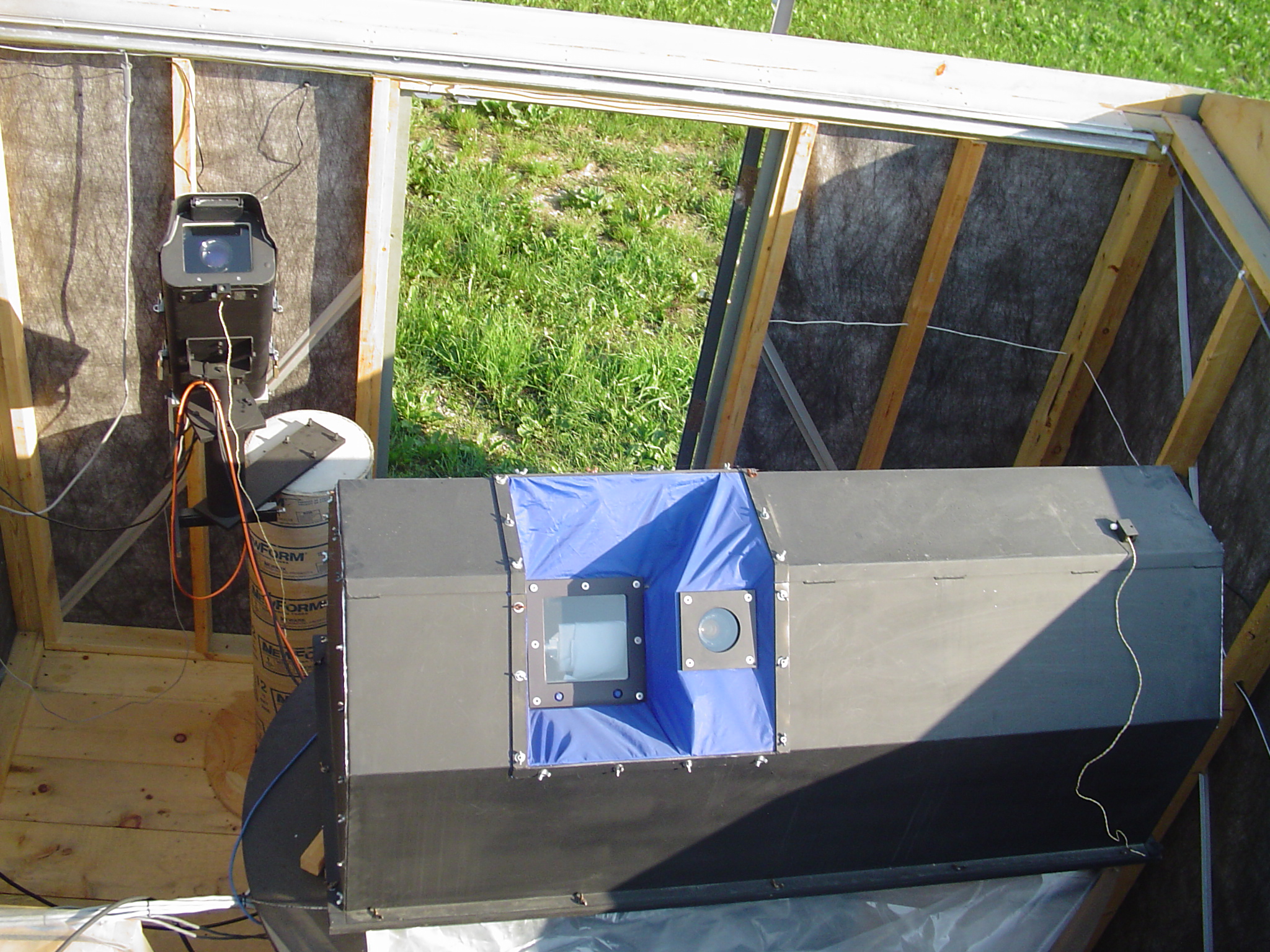
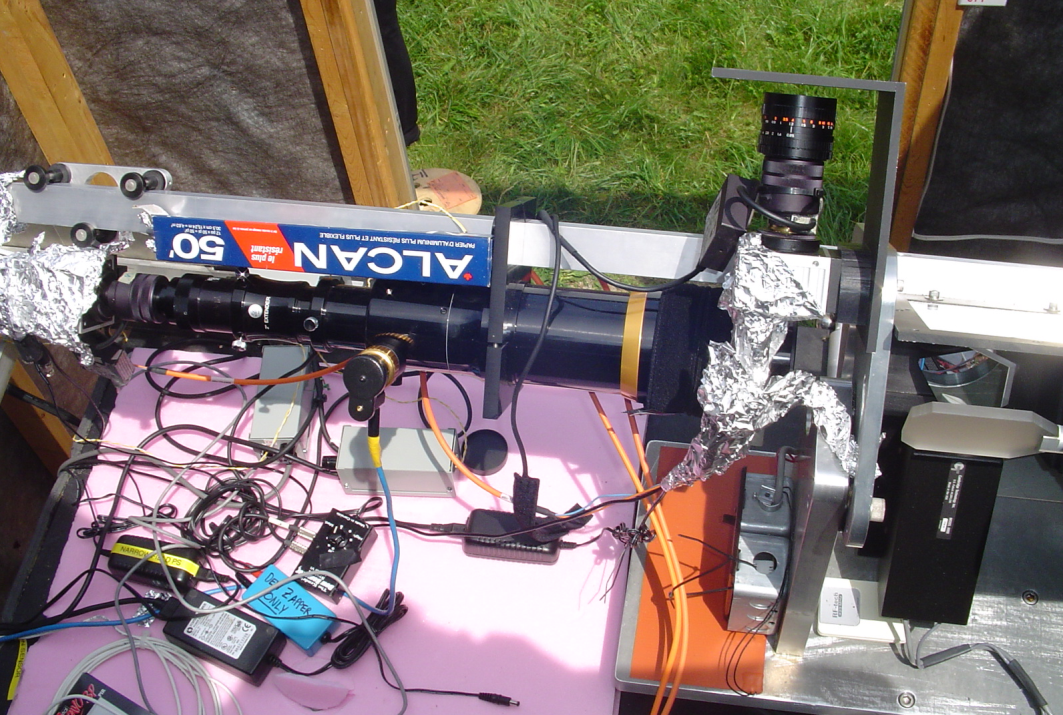
The Canadian Automated Meteor Observatory (CAMO) provides high-sensitivity and high-resolution optical observations that complement the radar data. Instruments are deployed at two stations — Elginfield Observatory and the Tavistock site (~45 km baseline) — enabling two-station trajectory determination.
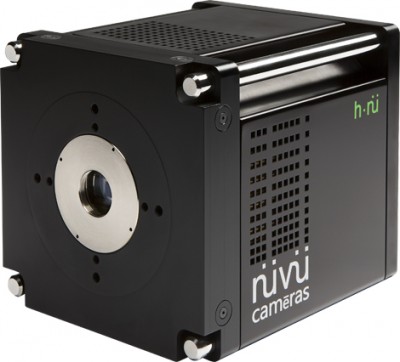
EMCCD cameras (Nuvu HNu1024, 1k×1k chip, 13 μm pixels, >90% QE, up to 5000× electron-multiplying gain) ran at 30 fps with a 15° field of view, reaching limiting magnitude +8. Since 2017 more than 130,000 double-station EMCCD orbits have been collected with automated data reduction. In 2025, the lenses were changed to observe fainter meteors.
The tracking mirror system locks onto a meteor within ~0.1 s of detection by the wide-field camera, slewing at up to 1000°/s. The 1.5° narrow field is recorded at 80–120 fps, resolving metre-scale structure in meteor trains. At this resolution, fragmentation, differential deceleration of fragments, and fine wake morphology become directly observable.
- Wide field: 26×19°, 640×480 pixels, 80 fps, lim. mag +5
- Narrow field: 1.5×1.2°, 640×480 pixels, 110 fps, lim. mag +7
- EMCCD all-sky system: lim. mag +8, 30 fps, 15° FOV
- CAMO-S spectrograph: ~8° FOV, 20 fps, lim. mag +3
Selected publications
- Campbell-Brown (2015) — Population of small refractory meteoroids in asteroidal orbits (Planet. Space Sci. 118)
- Stokan et al. (2013) — Optical trail widths of faint meteors (MNRAS 433)
- Subasinghe et al. (2016) — Physical characteristics of faint meteors (MNRAS 457)
Meteor Shower Fluxes and Observing Biases
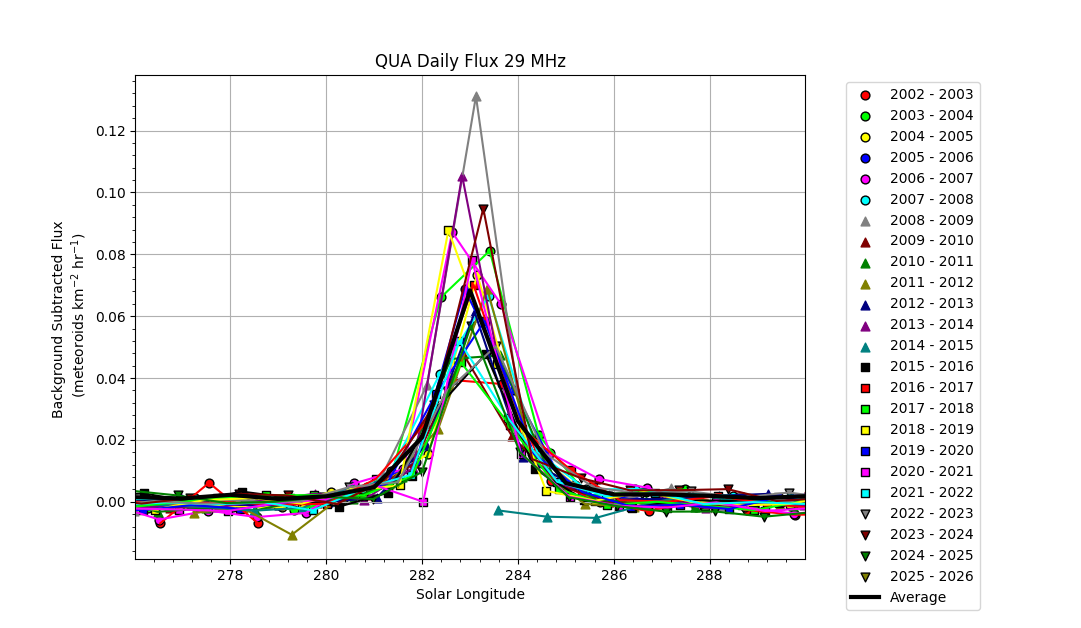
Converting raw radar echo counts into physical meteoroid fluxes requires correction for several wavelength-dependent and speed-dependent biases. Our group has systematically characterised these effects using 8 years of simultaneous EMCCD and CMOR observations, yielding 10,503 dual-detection events that directly constrain the fraction of optical meteors missed by the radar.
Key corrections include:
- Initial radius effect — ionization column wider than the wavelength causes destructive interference; more severe at shorter wavelengths
- Finite velocity effect — The ionization in the trail spreads in the time it takes a slow meteoroid to cross the first Fresnel zone
- PRF effect — the pulse repetition frequency limits detection of very short-lived echoes from fast meteors
- Faraday rotation — Earth's magnetic field rotates the polarization plane during propagation through the ionosphere, attenuating echoes with certain geometries
Our key finding: fast showers (Perseids, Leonids) have been significantly undercorrected in the literature, while medium-speed showers (Geminids, South Delta Aquariids) have been somewhat overcorrected. The corrections depend on meteoroid density/strength, not just speed, which explains the discrepancy between 29 and 38 MHz flux measurements for the same shower.
For short-duration outburst showers such as the Draconids (October 8 each year), multi-longitude radar networks are essential since flux can change significantly within the duration of a single-site observing window.
Selected publications
- Campbell-Brown (2026) — Correcting radar meteor fluxes for observing biases (Icarus 455)
- Campbell-Brown et al. (2021) — Radar observations of Draconid outbursts (MNRAS 507)
- Campbell-Brown et al. (2006) — The 2005 Draconid outburst (A&A 451)
- Campbell-Brown & Brown (2015) — A 13-year radar study of the η-Aquariid shower (MNRAS 446)
The Sporadic Meteoroid Complex
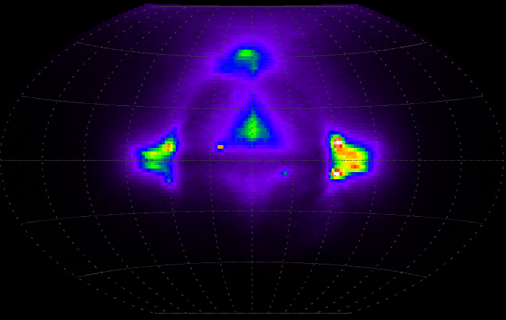
Sporadic meteors — those not belonging to a recognized shower — form the majority of the meteoroid flux at Earth. Rather than being uniformly distributed on the sky, they concentrate into six distinct broad sporadic source regions:
- Helion and antihelion sources — low-inclination ecliptic meteoroids arriving near the direction of the Sun and opposite the Sun
- North and south apex sources — mainly retrograde meteoroids concentrated near Earth's apex of motion
- North and south toroidal source — high-inclination meteoroids with near-polar orbits; in the Northern hemisphere only the North source is visible
Analysis CMOR orbital data characterised the absolute and relative fluxes of the five sources visible from our hemisphere, and their annual variations, corrected for radar observing biases. The seasonal variation in source activity is of direct interest for constraining the dynamical history of the populations and the dust production rates of their parent bodies (comets and asteroids).
Subsequent work used 2.35 million high-quality CMOR orbits to resolve the orbital structure of the sporadic complex at 2° resolution, revealing sub-structure within each source and constraints on orbital evolution timescales.
Selected publications
- Campbell-Brown & Jones (2006) — Annual variation of sporadic radar meteor rates (MNRAS 367)
- Campbell-Brown (2008) — High-resolution radiant distribution of sporadic meteoroids (Icarus 196)
- Campbell-Brown & Wiegert (2009) — Seasonal variations in the north toroidal sporadic source (Met. & Plan. Sci. 44)
- Wiegert, Vaubaillon, & Campbell-Brown (2009) — Dynamical model of the sporadic meteoroid complex (Icarus)
Meteoroid Physical Properties
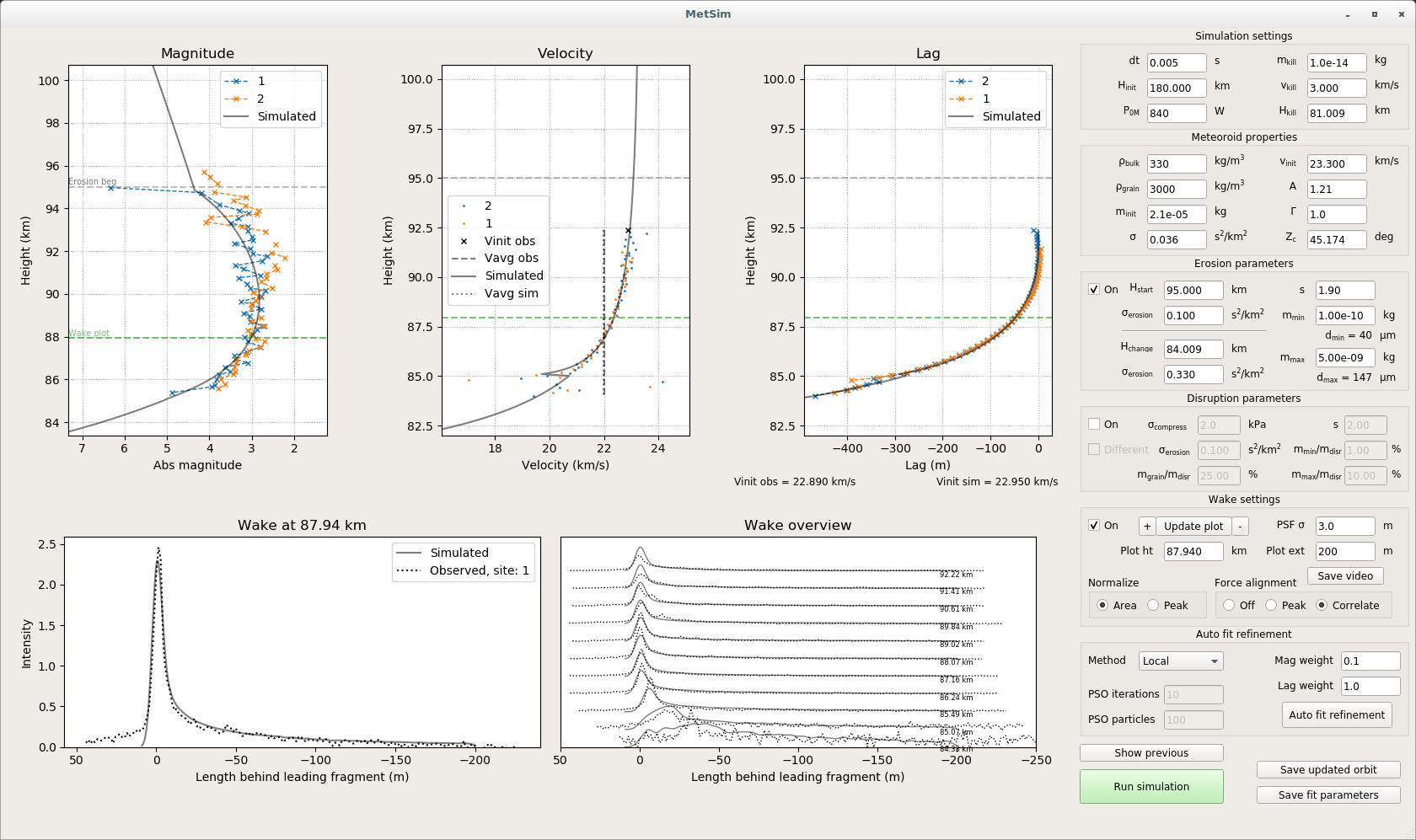
The high-resolution CAMO tracking mirror system resolves individual meteors at metre-scale, making it possible to directly observe fragmentation events, measure differential deceleration between fragments, and model the morphology of meteor wakes.
A survey of ~400 meteors observed by CAMO between 2010 and 2014 found that ~90% show evidence of fragmentation — a result that applies equally to meteors on cometary and asteroidal orbits, contrary to expectations. Light curve shapes are predominantly symmetric, with a mean F parameter of 0.49, consistent with roughly uniform mass loss along the trail.
Transverse motion of fragments has been measured directly in nine fragmenting events, yielding fragment speeds of order 100 m/s perpendicular to the meteoroid trajectory — far exceeding aerodynamic lift predictions and requiring rotation or cometary spin-up scenarios.
Selected publications
- Campbell-Brown & Koschny (2004) — Model of the ablation of faint meteors (A&A 418)
- Campbell-Brown, Borovička, Brown, & Stokan (2013) — High-resolution modelling of meteoroid ablation (A&A 557)
- Stokan & Campbell-Brown (2014) — Transverse motion of fragmenting faint meteors (Icarus)
- Stokan & Campbell-Brown (2015) — Particle-based model for ablation and wake formation (MNRAS 447)
- Subasinghe, Campbell-Brown, & Stokan (2016) — Physical characteristics of faint meteors (MNRAS 457)
- Vida et al. (2024) — First holistic modelling of meteoroid ablation and fragmentation: Orionids (Icarus 408)
Meteor Spectroscopy and Luminous Efficiency
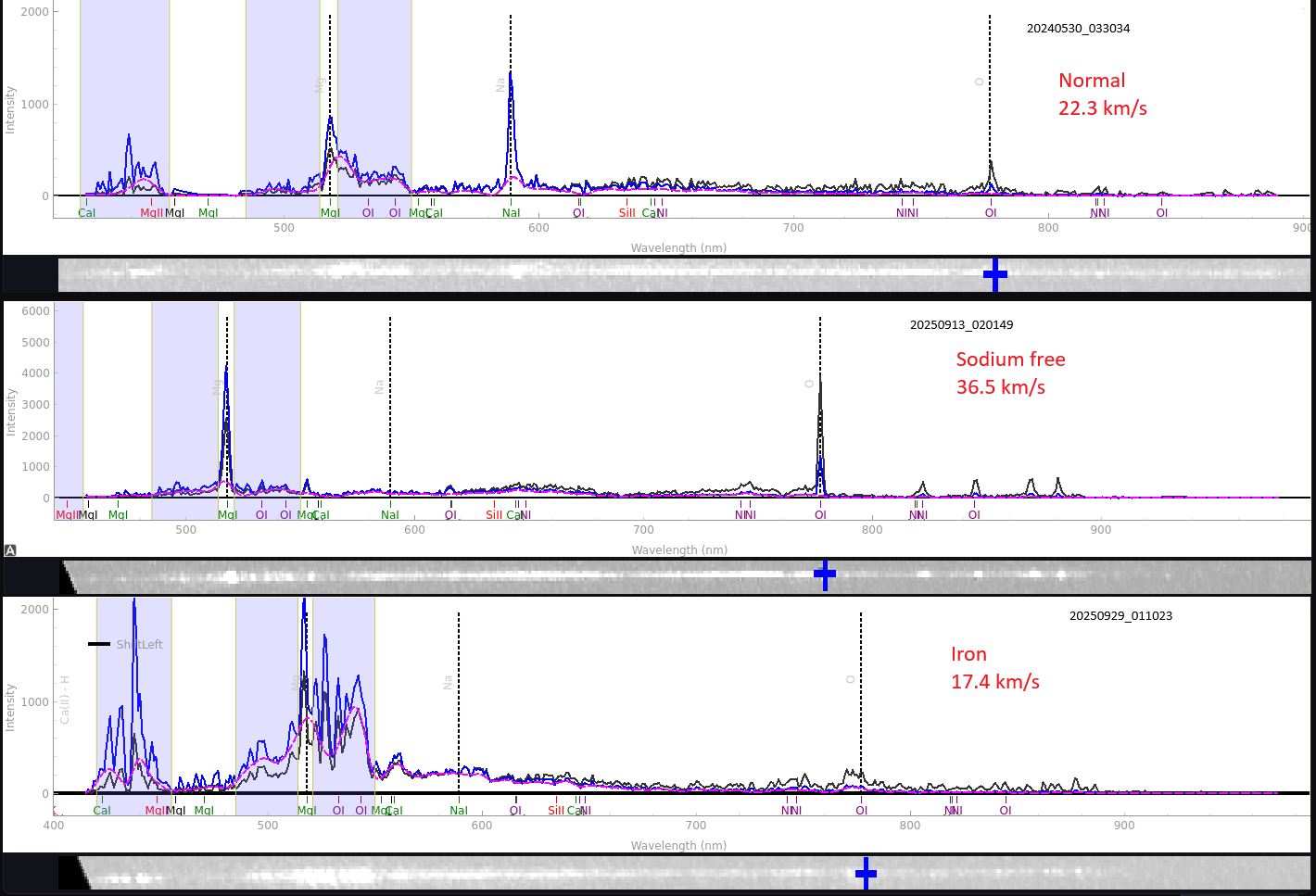
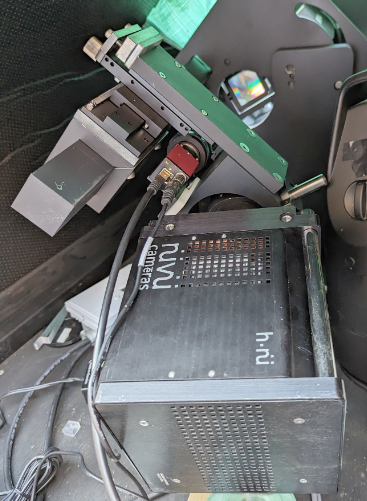
CAMO-S (the CAMO Spectral system) uses an EMCCD camera and a second tracking mirror pair to record slitless spectra of meteors to magnitude +3 at ~8° field of view and 20–30 fps. This makes it one of the few systems in the world capable of spatially-resolved spectroscopy of faint meteors.
The spectral data allow classification of meteors by composition. Preliminary analysis of the distribution of spectral types shows three broad categories: iron-rich (prominent Mg I, Fe I), sodium-enhanced, and normal chondritic composition (Mg, Na, Fe in solar proportions). Iron-dominated spectra are preferentially found among the slow, low-altitude population, consistent with the refractory meteoroid population described below.
A key future application of the spectral data is the direct determination of luminous efficiency — the fraction of kinetic energy radiated in the visible. This is poorly constrained (uncertainties of an order of magnitude), yet critical for converting meteor brightness into meteoroid mass.
Selected publications
- Dewsnap & Campbell-Brown (2026) — Meteor luminous efficiencies from simultaneous multi-frequency radar and high-resolution optical observations (Icarus)
- Subasinghe & Campbell-Brown (2018) — Luminous efficiency estimates of meteors II (AJ)
- Subasinghe, Campbell-Brown, & Stokan (2017) — Luminous efficiency estimates I: uncertainty analysis (Planet. Space Sci.)
- Mazur et al. (2024) — CAMO-S: A meteor-tracking spectrograph (AJ)
Small Refractory Meteoroids in Asteroidal Orbits
Analysis of more than 7000 two-station meteors observed with the CAMO EMCCD system revealed a population of faint meteors with unusual properties: they begin ablation at altitudes below 86 km (far lower than predictions from standard ablation models for stony meteoroids), have slow geocentric speeds (<25 km/s), and come from asteroidal orbits with Tisserand parameter TJ > 3.
These properties are consistent with millimetre-sized pieces of iron-rich material. Their early-peaked light curves and the absence of a cometary counterpart at these orbital elements suggest an asteroidal origin; possibly fragments from the collisional disruption of iron meteorites or iron inclusions.
This population is conspicuous in the more sensitive EMCCD cameras (limiting magnitude +6.5) but largely absent from the tracking mirror data (limiting magnitude +4), suggesting either a very steep mass-frequency distribution at these sizes, or very compact, high-density objects that are bright only briefly at the start of ablation.
Selected publications
- Campbell-Brown (2015) — A population of small refractory meteoroids in asteroidal orbits (Planet. Space Sci. 118)
- Subasinghe et al. (2016) — Physical characteristics of faint meteors (MNRAS 457)