
New (2001-10-11): Most recent scientific analyses.
Introduction
The Tagish Lake fireball occurred on January 18, 2000 at approximately 16:43 UT (08:43 PST local). This exceptionally long and bright fireball was seen throughout the Yukon, northern British Columbia, parts of Alaska, and the Northwest Territories. Thousands of residents witnessed the event and many secured photos and video of the resulting dust cloud; some produced drawings of what they saw. Scientists from the University of Calgary and Western University began collecting data in February 2000, in close cooperation with the original finder of meteorites, Mr. Jim Brook. Expeditions in mid-February secured sufficient instrumental records to derive an atmospheric path, with further refinements from additional data gathered in early April during a second expedition.
This second expedition (April 6 to May 12, 2000) included significant ground recovery operations beginning April 20, when the first additional meteorite fragments were recovered from the lake ice. Continuous recovery by Western, U of C, and Jim Brook from April 20 to May 8 — until the lake ice became too unstable — located ~500 additional meteorites, documented 410 of these, and recovered ~200. The photo gallery shows the methods of retrieval on the ice and the general condition of the meteorites.
Satellite detection
The impacting meteoroid was detected by both infrared and optical sensors aboard US Department of Defense satellites, which timed the terminal flares to 16:43:42 with a two-second duration at 1-micron radiation. Optical measurements showed the flash energy to be 1.1 × 10¹² J (1.1 terajoules). Bolides of H-chondrite composition have light-energy conversions of order 10%; given the low iron content, a more realistic value here is probably ~5% (Nemtchinov, pers. commun.), yielding a total energy release of ~2 × 10¹³ J, or ~5 kilotonnes equivalent. This could be the largest meteor impact ever recorded by satellite sensors over land.
The satellites also suggested an entry velocity of ~16 km/s. This velocity and the total estimated energy imply an entry mass somewhat in excess of 150 tonnes and an entry diameter of ~5 metres.
Eyewitness accounts
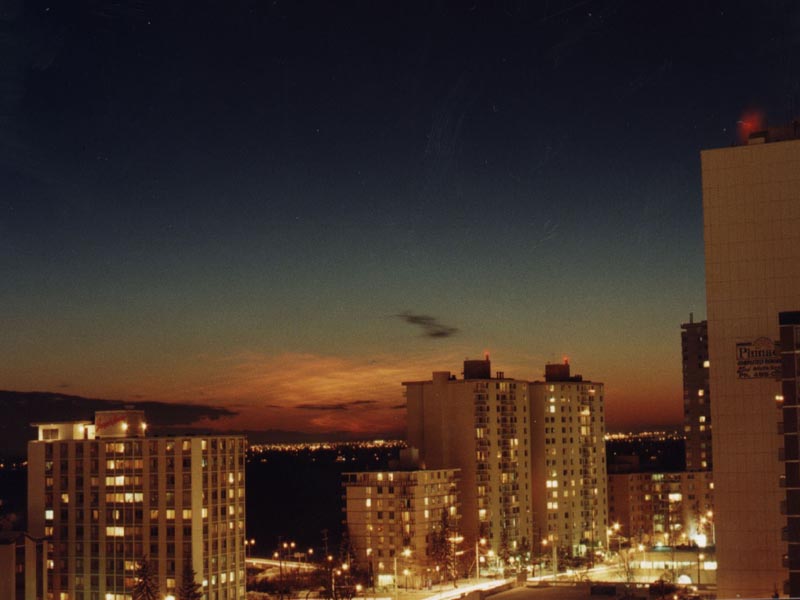
Approximately 70 eyewitnesses of the fireball and resulting dust cloud were interviewed. The fireball was generally described as a multicoloured object with a tail. It produced a spectacular dust trail visible for ~2 hours locally as it drifted southeast on high-altitude winds. These same clouds are believed responsible for a spectacular display of noctilucent clouds seen from Edmonton, Alberta during evening twilight later that day (seen here).
Eyewitnesses placed the duration of the fireball at ~15 seconds, consistent with a slow fireball. The brightest of the two terminal flares was described as lighting up the landscape ten times brighter than daylight, with a bluish to greenish light. As is typical, approximately one in ten witnesses described sounds simultaneous to the fireball, presumed to be an electrophonic effect. Witnesses also frequently described smells — sulphurous, and sometimes hot metal and rock — with prompt occurrences from distances as large as 100 km from the ground projection of the fireball.
Ground-shaking detonations were widely recorded by seismographs and followed the fireball by several minutes, but were generally of short duration.
Dust cloud / orbit
The singular size of this event made most residents aware of it. Many saw the fireball illuminated only indirectly but were soon outside photographing the dust clouds lit by morning twilight (the sun was 6° below the local horizon at the time). Photos of the dust cloud are available on the dust cloud photos page.
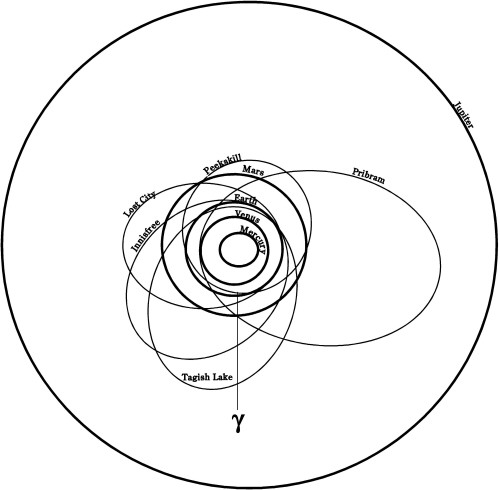
An orbit was found with the following characteristics:
| a (semimajor axis) | 2.1 ± 0.2 AU |
|---|---|
| e (eccentricity) | 0.57 ± 0.05 |
| q (perihelion distance) | 0.891 ± 0.009 AU |
| ω (argument of perihelion) | 222° ± 2° |
| Ω (longitude of ascending node) | 297.900° ± 0.003° |
| i (inclination) | 1.4° ± 0.9° |
| T (orbital period) | 3.0 ± 0.4 years |
| ΔT (time since perihelion) | 1072 ± 164 days |
| Q (aphelion distance) | 3.3 ± 0.4 AU |
| Vinf (entry velocity) | 15.8 ± 0.6 km/s |
Meteorite recovery
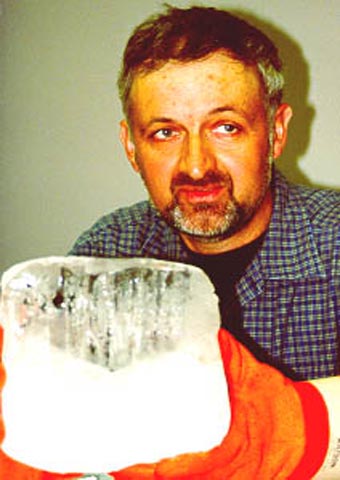
On January 25 near dusk, a local resident, Jim Brook, found meteorites on the snow-covered ice of Taku Arm of Tagish Lake while driving home. He returned the next day to collect several dozen meteorites in total. The meteorites represent a particularly fragile variety of carbonaceous chondrite. They were collected without skin contact and have been kept frozen since. During the spring melt, ~500 additional meteorites were recovered from a strewn field ~16 km long and ~5 km wide, oriented at ~150°. For a detailed map of the recovery area, see the recovery map.
Information from the Meteoritical Bulletin
Tagish Lake — 59°42′15.7″N 134°12′4.9″W, British Columbia, Canada. Fell 2000 January 18, 08:43:42 PST (16:43:42 UT). Carbonaceous chondrite (C2, ungrouped).
A brilliant fireball followed by loud detonations was widely observed over the Yukon Territory and northern British Columbia, and was also detected by satellites in Earth orbit. Dust clouds from terminal fragmentation events were widely observed. Mr. Jim Brook recovered several dozen meteorites totalling ~1 kg on the ice of Taku Arm on January 25 and 26. Between April 20 and May 8, ~500 additional specimens were located on the ice of Taku Arm and a small, unnamed lake 1.5 km to the east; only ~200 were retrieved, as many had melted down into the ice. The total mass collected was between 5 and 10 kg. The strewn field is at least 16 km by 3 km, oriented ~S30°E. Classification and mineralogy (M. Zolensky, JSC; M. Grady, NHM): possibly CI2 group; a matrix-dominated chondrite with a few small chondrules, CAIs and isolated grains; matrix mainly phyllosilicates, Fe-Ni sulfides and magnetite, with abundant Ca-Mg-Fe carbonates; olivine Fa0-29 (peak Fa1); pyroxene Fs1-7 (peak Fs2); bulk C content 5.4 wt%; shock stage S1. Oxygen isotopes (R. Clayton, UChicago). Specimens: majority held by U Calgary (contact A. Hildebrand) and Western (contact P. Brown).
Contact information
Alan Hildebrand — University of Calgary — hildebra@geo.ucalgary.ca
Peter Brown — Western University — pbrown@uwo.ca